

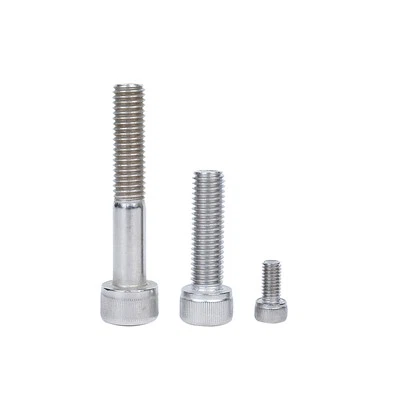
When discussing the tensile strength comparison of nails and screws, we first need to understand the basic differences between the two in design and application. Nails are usually used for simple connections and fixation, such as nailing wooden boards together, while screws are more commonly used in situations that require higher strength and more precise connections, such as the assembly of mechanical parts.
Tensile Strength of Screws
The strength grade of a screw is an important indicator for evaluating its quality and performance. The strength grade of a screw usually consists of two parts, such as 4.8, 8.8, 12.9, etc. Among them, the number before the decimal point represents the tensile strength of the screw, usually in megapascals (MPa); the number after the decimal point represents the shear resistance of the screw, also in megapascals. For example, a screw with a grade of 8.8 means that its minimum tensile strength is 800MPa and its minimum shear strength is also 800MPa. The tensile strength calculation formula of the screw is F=k*As*σs, where F is the tensile strength of the screw, k is the coefficient, As is the effective cross-sectional area of the threaded part, and σs is the tensile strength of the threaded part material.
In practical applications, the tensile strength of the screw is affected by many factors, including the diameter, length, material, and treatment method (such as heat treatment) of the screw. Generally speaking, the larger the diameter, the shorter the length, and the better the material performance, the higher the tensile strength of the screw.
Tensile strength of nails
In contrast, nails are usually not as good as screws in terms of tensile strength. Nails are mainly used for simple connections and fixation, and their design does not focus on maximizing tensile strength. The tensile strength of nails is affected by many factors such as their materials, diameter, length, and usage. Generally speaking, nails have low tensile strength and are suitable for some occasions that do not need to withstand excessive tensile force.
Comparison and summary
In summary, screws are usually better than nails in terms of tensile strength. The design of screws focuses more on tensile strength and precise connection, while nails are more suitable for simple connections and fixation. In practical applications, appropriate connectors should be selected according to specific needs and occasions to ensure the firmness and safety of the connection. If a large tensile force needs to be withstood or a more precise connection is required, screws are usually a better choice. In some simple connection and fixing occasions, nails may be more convenient and practical.